The words we use, and the ones we do not
Nexusland has a vocabulary of its own. The Public Lexicon is the plain key to it: what each term means, what it does not mean, and which words the project keeps away from itself.

Every project that names things runs a risk: a word can promise more than the thing behind it. Nexusland names a great many things (Houses, Residents, cities, a feed) and has built almost none of them yet. So it keeps a short public glossary, and it uses the glossary as a place to be exact.
The document is called the Public Lexicon. It says what each term means and, “where a word might be misread”, what it does not mean. Its entries are grouped by theme rather than by alphabet, so that a newcomer can read them in order. This article keeps to that order.
Nexusland is a cultural and worldbuilding project by Roman Kotlar — not a country, a government, a bank, a religious authority, or a provider of legal status.The Public Lexicon, Nexusland canon
The same opening note goes on: Resident, House and the names of cities are the vocabulary of the project and its imagined world. None of them grants a legal status, anything financial, or real territory.
01The world and its idea
Four names at the centre
- Nexusland
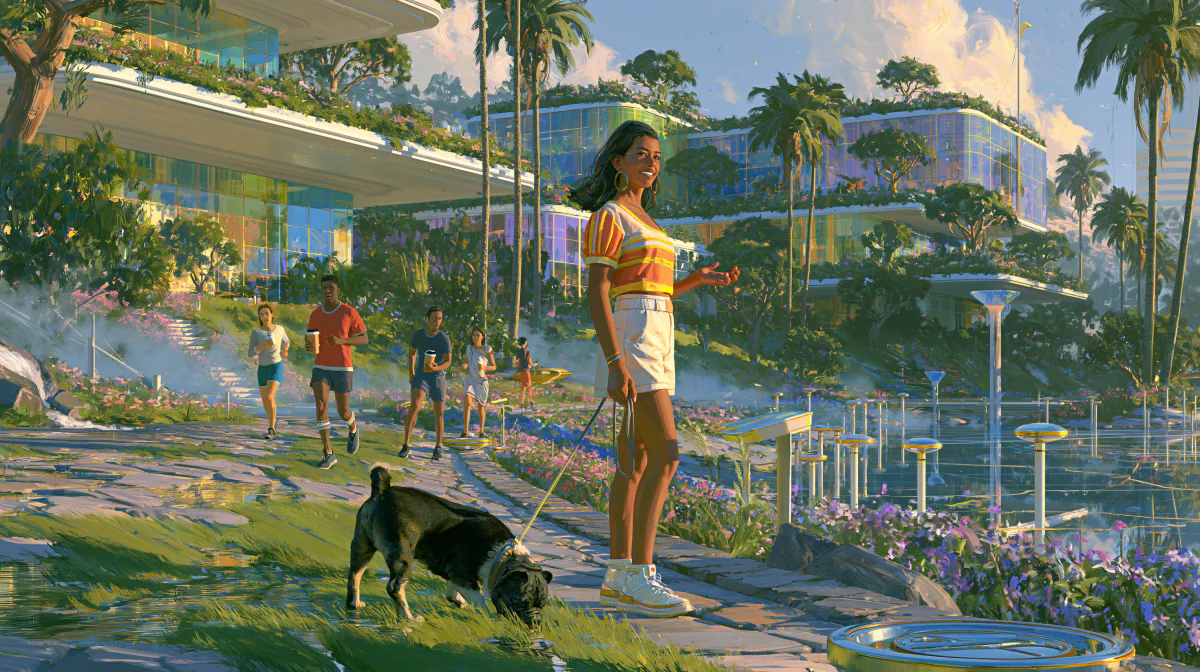
- The project itself: a cultural and worldbuilding venture building toward a humane “digital civilization”: a feed, a set of standards, a community and, on a long horizon, physical places. Written as one word.
- Pax Nexica
- The principle at the centre: ordered peace, disciplined harmony, strength without cruelty, ambition without contempt, and dignity protected by structure rather than crushed by it. A cultural posture, not a political body and not a treaty.
- Luminous Futurism
- The visual and cultural-technological doctrine: the future imagined as bright, humane, ordered and beautiful, with light, nature and technology in the service of the person.
- Agape
- Self-giving, selfless love: the highest reference the project holds. It sits beneath both Luminous Futurism and the Ideals.
One line stands above the glossary. The Project Passport, a one-page canon statement, gives it as the project’s slogan: “We build the promised future.”
02The people
Resident, House, rank
- Resident
- The name for anyone who joins. It signals inhabiting a world of shared standards and direction, rather than merely “using” a platform. It is not legal residency or any immigration status.
- House
- A developmental orientation and symbolic identity that a Resident chooses. Not a caste, a rank or a locked group: a House can be changed, about once a year. There are four: House of Mentis, House of Fortitudo, House of Cultura and House of Aequalitas.
- The rank path
- Visible progression that marks growth, reliability and service: not vanity, and never something money can simply buy. It begins at Novus, “the dignified beginning”, and rises to Curator, a rank that signifies care for the whole rather than accumulation.
- The Ideals
- The moral foundation of the project. No person, vote, leader, House, council or temporary majority stands above them.
- Canon
- The body of official documents and definitions, kept consistent over time.
These definitions should be read beside one fact. No House has members, and nobody holds a rank. There is no live product yet. Here is what we are building. The words were defined before the things exist; as we read it, that is the point of defining them.


03Where it is meant to be met
The feed and the map
- Universal Feed
- The central interface, as the canon designs it: a single stream where content, missions, learning and tools coexist, built as an active surface that helps people grow, not a passive scroll designed to hold their attention.
- The map
- One imagined world map. Everything on it is symbolic and community-based: “a picture of belonging, not real territory, sovereignty, or property.”
- The Earth cities
- Ten symbolic regional cities, from Northslight to Oceanis, each gathering a region of the world. Beyond them the map shows three far places, drawn locked: “directional symbols, not present-day promises.”
04Safe descriptions
What we do call ourselves
The canon keeps a small set of descriptions that claim no more than is true. These are the ones this paper uses.
- A cultural and worldbuilding project
- The Lexicon’s own first description, and the plainest.
- The first social world
- The category named in the Project Passport: a network built as a civilization, which people “do not scroll” but inhabit. The Passport guards the name Nexusland and gives these two words away: “a category, not a trademark.” It is the direction of the build, not a finished thing.
- Luminist
- The Passport’s word for a person who holds to Luminous Futurism; formally, a Luminous Futurist.

05Refused words
What we do not call ourselves
The second list is longer. The Communications and Legal Guardrails, a working document of the canon, sorts public language by risk and sets a test. If an uninformed journalist, parent or regulator could read a sentence and reasonably believe the project is claiming official powers, official identity or regulated financial services, the sentence must be changed.
So we do not call Nexusland a country or a government, and we do not call its bodies ministries. We do not call a local group an embassy. The word “visa” is never used, because the project neither issues nor imitates documents. We do not call anything of ours a bank or a currency. And we do not offer anyone land: the map is a picture.
The Naming Convention gives the rule behind the list in four short lines. No name may imply a legal status. No name may suggest a financial instrument. No name may take the standing of a religious authority. And nothing is named to exalt any person.
06Across languages
Why the terms stay in English
Readers of our Ukrainian edition will see that Resident, House of Cultura, Universal Feed and the names of the cities are left exactly as they are written here. This follows the Naming Convention: “A canonical proper name keeps its original form in every language.” It lists Houses, ranks, bodies, offices, cities and documents among the names that are not translated.
The reason is the one that runs through the whole Lexicon. A coined world, the Convention says, “is fragile in a way the real one is not: its names have no soil to grow back from if they scatter.” A name spelled five ways in five languages begins to mean five things. So this paper keeps each term in one form, and explains it in the reader’s own language the first time it appears.

07What comes next
A key that grows and does not drift
The Lexicon expects to change. “A living language keeps growing,” it says, “and this key will grow with it.” Its last paragraph then makes the one promise a glossary can keep:
What it will not do is drift: the words here mean what they say, and where a term could promise more than the project honestly offers, the lexicon is the place we say so out loud.The Public Lexicon, Nexusland canon
CANONThis article summarises documents of the canon: definitions of how the world is designed, not a description of something in operation. The Public Lexicon has more entries than are shown here.
Sources
- 1Nexusland canonThe Public Lexicon (June 2026)
- 2Nexusland canonThe Naming Convention v2.0, sections 1–2, 5 and 21–22
- 3Nexusland canonCommunications and Legal Guardrails, sections 3–5
- 4Nexusland canonProject Passport
- 5Nexusland canonThe City and the Communities, section 14 (on the word “visa”)
Published in the first edition, 20 November 2026. Signed by the paper: Nexusland Today. If a fact here is wrong, it will be corrected openly, with a date. Corrections