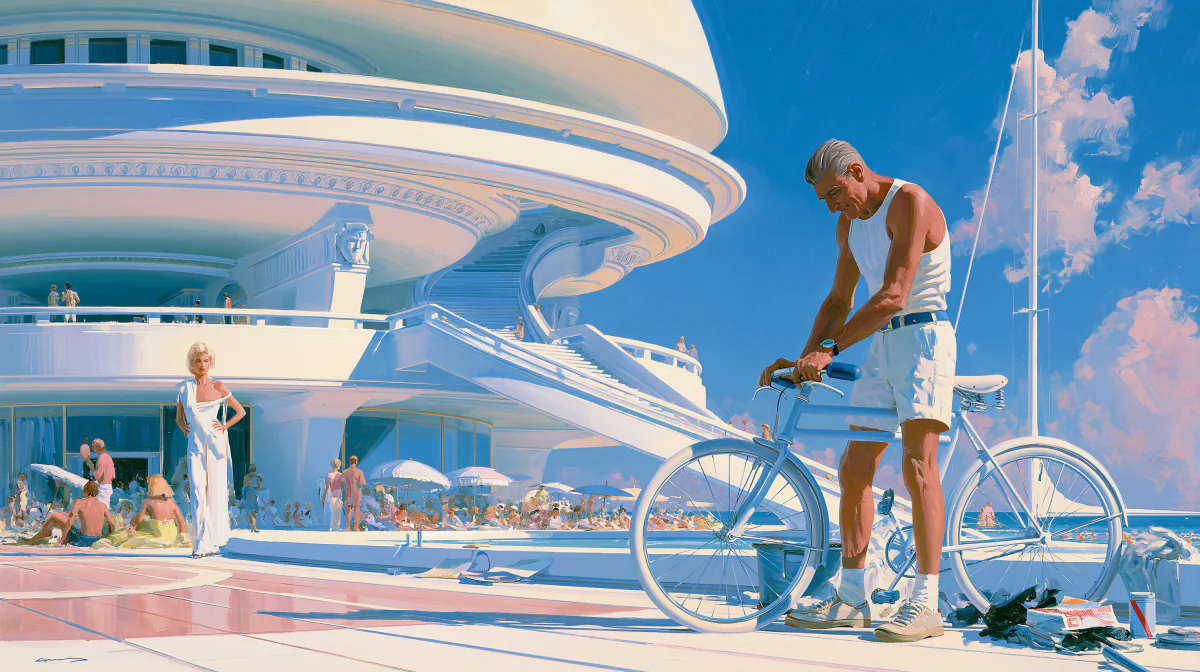
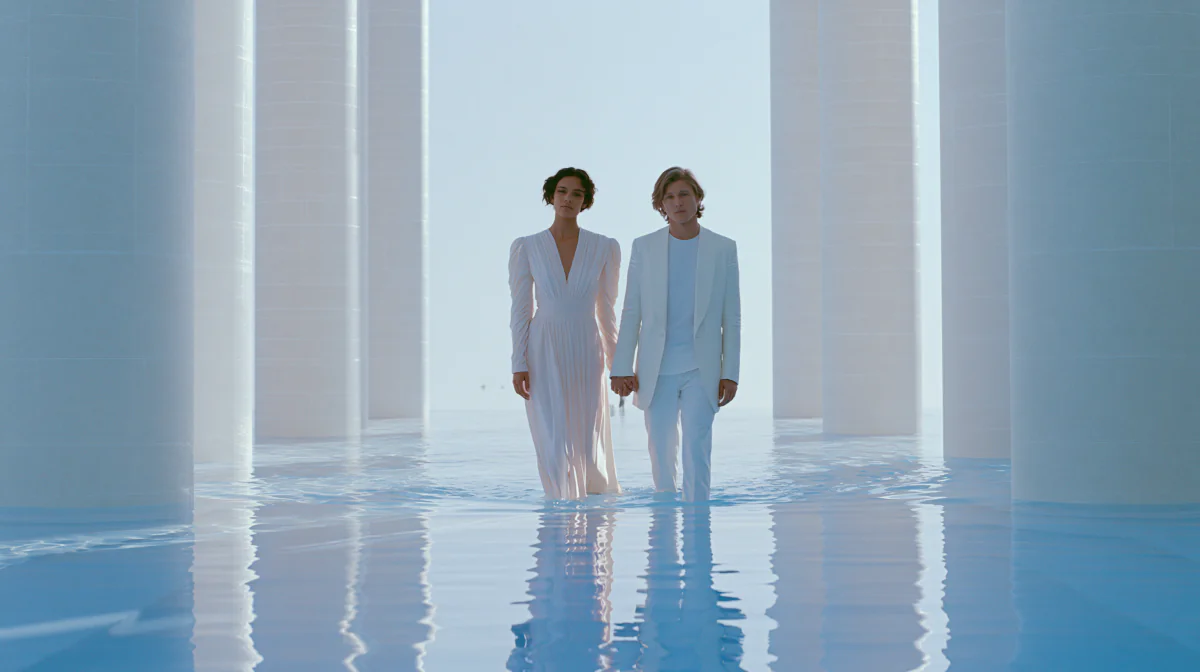
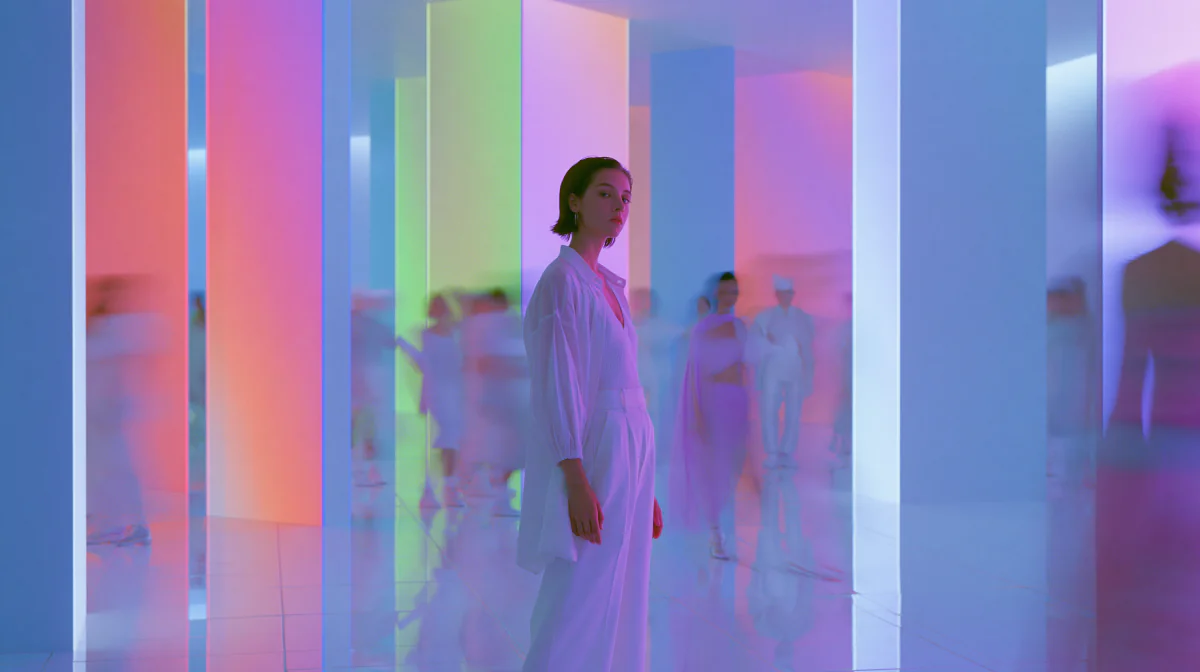
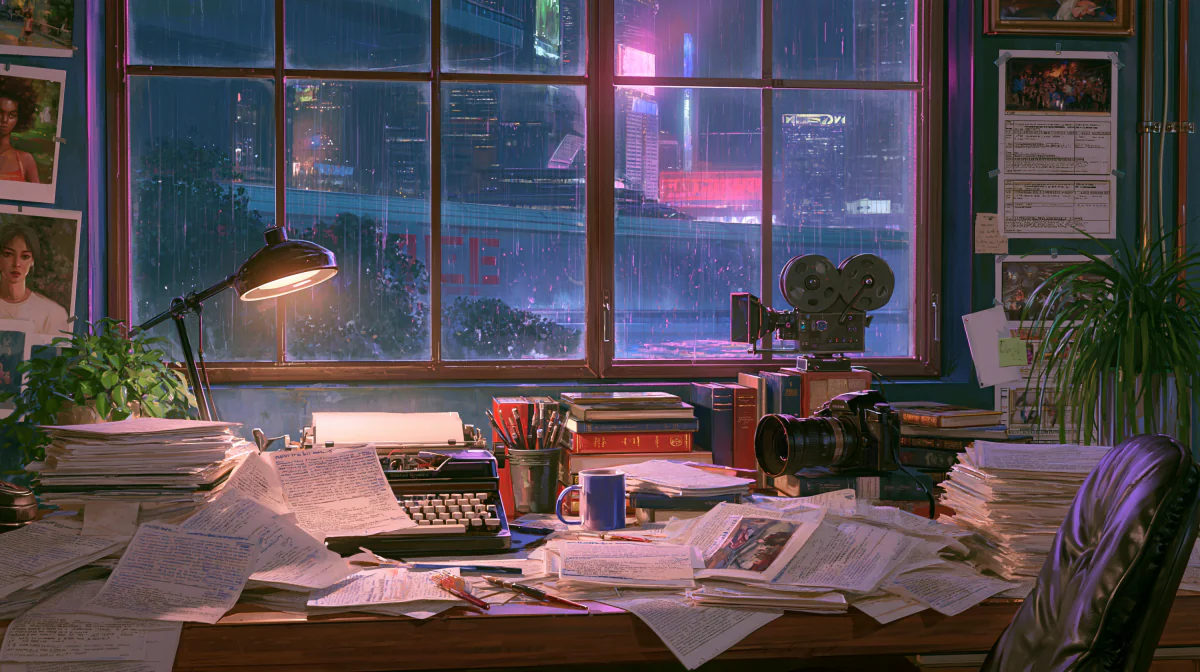
Episode 01 is filmed: “Rain. Neon. Darkness.”
The first film of the Nexusland channel asks why every future on our screens looks the same, and offers one principle to start from. Here are its chapters, its sources, and how it was put together.

The first episode of the Nexusland channel is filmed and assembled in a first cut. It runs just under nine minutes. It opens with three words — rain, neon, darkness — and closes with an invitation: find one image of a future that feels like home.
PROTOTYPEThe film is not released yet. No date; it ships when it is ready. The chapter order below is from the first cut and may still change.
01The film
Seven chapters, one argument
- 01 · The hook
- Every future on our screens looks the same. Name one you would want to live in.
- 03 · The expectation
- The dark ink is already in what we expect for our children[3], and stories change what people are willing to justify[4].
- 04 · The objection
- Dystopias are warnings, and warnings are useful. But a warning is not a map.
- 05 · Principle No. 1
- Before you build a future, you have to be able to picture one you would want to live in. A picture once changed reality[5][6].
- 06 · The direction
- Daylight after neon. A garden after a dark alley. A civic square after a corporate maze. The direction is called Luminous Futurism.
- 07 · The project
- Nexusland begins with a diagnosis, not with a product. What exists is the foundation.
A warning repeated too often becomes a destination.Episode 01, Nexusland channel
02The sources
Every number in the film, and where it comes from
A film moves faster than a reader can check. So the companion does the checking in the open. In January 2025 Pew Research Center published a survey of 36 nations. A median of 57% of adults said that children in their country will grow up to be financially worse off than their parents; a median of 34% said better off[3]. In the United States the “worse off” answer was given by 74%, in Canada by 78%, in the United Kingdom by 79%, in France by 81%.
In 2018 the political scientists Calvert Jones and Celia Paris reported three experiments in the journal Perspectives on Politics. They found consistent evidence that dystopian narratives increase the willingness to justify radical — especially violent — forms of political action[4]. The finding is about what people are ready to justify, not about what they do; and the same paper found no evidence that such stories reduce political trust.
Star Trek first aired on 8 September 1966 and showed a hopeful future in which humanity worked together[5]. In 1977 NASA contracted Nichelle Nichols, who played Lieutenant Uhura, for a four-month campaign to encourage women and minorities to apply to be astronauts; NASA says it inspired hundreds to apply. The next astronaut class, appointed in 1978, included Sally Ride, the first American woman in space, and Guy Bluford, the first Black American in space[6].
03How it was made
One recording, sixty-seven takes
The first cut was assembled from a single recording. Sixty-seven takes were kept: a little under nine minutes of speech. Over the voice sit 47 graphic inserts — key phrases, a timeline, a chart, quotations, art — drawn from the same set of forms as the pages of this paper, with 13 music cues and 17 sound accents.
One rule shaped the picture. The canon’s guide for founder media says the speaker must look like “a steward of the world, not the object of the world”. So the film keeps returning to the art and to the argument, and away from the face.
04The question of the week
One object, one rule, one feeling
The film ends with a question for its viewers: what is one single thing — one object, one rule, one feeling — you would want to see in a better future? When the film is out, the answers will arrive as comments. The paper will print a reader’s words only with the author’s name and consent.
And it ends with a method, not a schedule. Each film takes one thing that feels broken and looks for the principle that could repair it. First the diagnosis. Then we can try to heal.
Sources
- 1Warner Bros.Blade Runner — original theatrical release 25 June 1982.
https://www.warnerbros.com/movies/blade-runner - 2The Encyclopedia of Science FictionWilliam Gibson — Neuromancer (New York: Ace Books, 1984).
https://sf-encyclopedia.com/entry/gibson_william - 3Pew Research Center · 9 January 2025Views of children’s financial future (survey of 36 nations, spring 2024).
https://www.pewresearch.org/global/2025/01/09/views-of-childrens-financial-future/ - 4Perspectives on Politics, vol. 16, no. 4 · December 2018Calvert W. Jones and Celia Paris, “It’s the End of the World and They Know It: How Dystopian Fiction Shapes Political Attitudes”.
https://www.cambridge.org/core/journals/perspectives-on-politics/article/its-the-end-of-the-world-and-they-know-it-how-dystopian-fiction-shapes-political-attitudes/3853105561CB840EAB79258DC2575849 - 5NASA History55 Years Ago: Star Trek Debuts, Begins an Enduring Relationship with NASA.
https://www.nasa.gov/history/55-years-ago-star-trek-debuts-begins-an-enduring-relationship-with-nasa/ - 6NASANichelle Nichols Helped NASA Break Boundaries on Earth and in Space.
https://www.nasa.gov/people-of-nasa/special-observances/nichelle-nichols-helped-nasa-break-boundaries-on-earth-and-in-space/ - 7Nexusland channelEpisode 01 working files: first cut and its edit list (length, takes, inserts).
- 8Nexusland canonThe Year One Roadmap: founder media and video style.
Published in the first edition, 20 November 2026. Signed by the paper: Nexusland Today. If a fact here is wrong, it will be corrected openly, with a date. Corrections